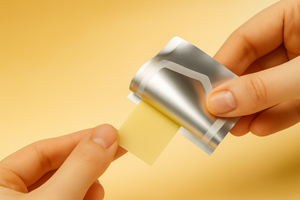
Core Mechanism (4 steps)
Wetting & dissolution: Saliva spreads; hydrophilic matrices (HPMC/pullulan/PVA) swell and dissolve rapidly (target ≤10 s).
Release & solubilization: Nicotine diffuses out of the film network; buffers/surfactants/cyclodextrins reduce sting and improve solubility.
Mucosal permeation: Absorption via sublingual/buccal mucosa partly bypasses first-pass metabolism → faster perceived onset.
Swallowed fraction: Unabsorbed nicotine is taken up in the GI tract, yielding dual-pathway exposure.
Efficiency Keys
Formulation: 50–120 μm thickness; balance salt/free-base ratio; control residual moisture/water activity; taste masking & pH micro-environment.
Physiology/Use: Saliva volume; mucosal health; sublingual/buccal placement; avoid chewing/swallowing until fully dissolved.
Differences vs Other Forms
Direct mucosal access to microcirculation → faster perception; unit-dose, discreet and portable; compared with patches, faster exposure with a shorter course.
Quality & Packaging Essentials
Release tests: assay & dose uniformity (CV ≤ ±2–3%), dissolution time, thickness/GSM, residual moisture, and sensory consistency.
Packaging: High-barrier four-side seal or blister (nitrogen/desiccant as needed); verify WVTR/OTR and logistics-humidity lanes.
Safety Notes (informational)
Nicotine is addictive; not for minors; use with caution or under medical advice during pregnancy/lactation or with cardiovascular disease.
Possible effects: oral irritation, nausea, dizziness, palpitations. Discontinue and consult a clinician if symptoms persist.