
Author: Sihan Meng, Leyu Zhu, Pengcheng Shi
Affiliation: RSBM
Email: pengchengshi@biotechrs.com; pcspc9@gmail.com
Abstract
In Oral Disintegrating Film (ODF) manufacturing, the drying section is the most yield-critical and risk-sensitive unit operation. Improper drying design leads to defects such as skinning, cracking, curling, active migration, blocking, and downstream cutting losses—often accounting for the majority of yield loss at scale. This paper analyzes the drying section as an engineered system, focusing on three decisive variables: temperature zoning, airflow volume/pattern, and moisture removal kinetics. We present a process-centric framework linking drying design to film integrity, residual moisture control, and overall yield rate, offering practical guidance for pilot-to-commercial scale implementation.
Introduction
Unlike tablets or capsules, ODFs are formed by solvent casting and require controlled solvent removal to transform a wet polymer matrix into a mechanically stable, dose-accurate film. Drying is not merely a dehydration step; it governs polymer chain mobility, glass transition behavior, internal stress development, and active ingredient distribution [1].
In industrial practice, many ODF failures trace back to drying sections that are either under-engineered (leading to incomplete drying and blocking) or over-aggressive (causing surface skinning, brittleness, and cracks) [2]. This paper examines how drying design variables interact and why yield rate is fundamentally determined in the drying tunnel rather than in coating or cutting.
Methods
This work integrates polymer drying theory, pharmaceutical film literature, and industrial ODF manufacturing experience. Drying behavior was analyzed by dividing the process into functional zones and mapping critical process parameters (CPPs) to critical quality attributes (CQAs). Emphasis was placed on convective drying mechanisms and their impact on film structure, residual moisture, and downstream yield [3].
Drying as a Multi-Zone Process
Concept of Zonal Drying
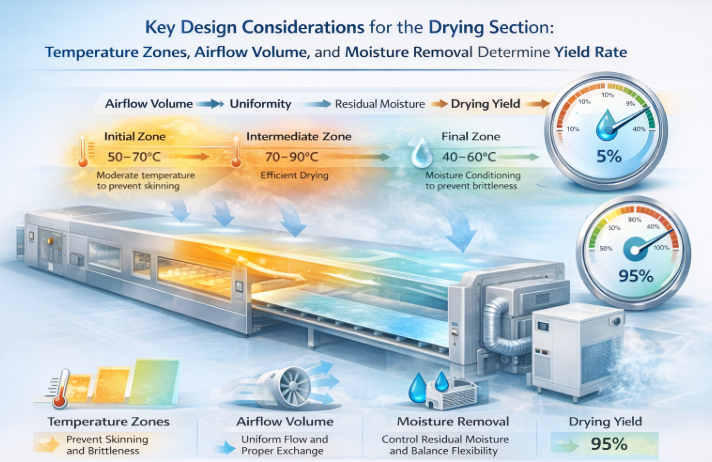
Industrial ODF dryers are typically designed as multi-zone tunnels rather than single-temperature ovens. Each zone serves a distinct function:
Initial setting zone – solvent evaporation initiation
Intermediate drying zone – bulk solvent removal
Final conditioning zone – moisture equilibration
This segmentation allows controlled solvent removal without inducing structural defects [4].
Temperature Zone Design
Initial Zone: Preventing Surface Skinning
The first drying zone must operate at moderate temperatures to avoid rapid surface evaporation. Excessive temperature here causes surface skinning, trapping solvent beneath and leading to bubbles or internal stress [5].
Design principle:
Low to moderate temperature, high humidity tolerance, controlled evaporation rate.
Intermediate Zones: Efficient Solvent Removal
The middle zones remove the majority of solvent. Temperature can be increased gradually as the film gains mechanical strength.
Design principle:
Stepwise temperature ramping synchronized with film strength development.
Final Zone: Moisture Conditioning
The final zone fine-tunes residual moisture to achieve optimal flexibility and stability. Over-drying at this stage increases brittleness and cutting loss [6].
Design principle:
Lower temperature, controlled airflow, moisture equilibration rather than aggressive drying.
Airflow Volume and Pattern
Role of Airflow in Convective Drying
Airflow determines the mass transfer rate of solvent vapor away from the film surface. Insufficient airflow leads to saturation and drying inefficiency; excessive airflow causes uneven drying and edge effects [7].
Laminar vs Turbulent Flow
Laminar airflow promotes uniform drying, while uncontrolled turbulence increases thickness variation and curl.
Design principle:
Uniform, well-directed airflow across the web width with minimal turbulence.
Moisture Removal Kinetics
Drying Rate vs Film Integrity
ODF drying follows a typical falling-rate period dominated by diffusion through the polymer matrix. Forcing faster drying does not proportionally increase throughput but sharply increases defect risk [8].
Residual Moisture Target
Residual moisture is not a defect but a design parameter. Films dried to absolute dryness often exhibit poor flexibility and higher breakage rates during slitting and die-cutting.
Design principle:
Define an optimal residual moisture window linked to Tg and mechanical performance.
Measures
Key indicators used to evaluate drying section performance include [9,10]:
Residual moisture content
Thickness and weight uniformity
Curling and edge lift incidence
Tensile strength and elongation
Yield after slitting and die-cutting
These measures directly correlate drying performance with final yield rate.
Results
Manufacturing data consistently show that optimized multi-zone drying improves usable yield by reducing crack formation, blocking, and cutting waste. Plants implementing staged temperature profiles and controlled airflow achieve significantly higher first-pass yield compared to single-zone or overly aggressive drying designs [11].
Discussion
The drying section should be treated as a precision engineering system rather than a generic oven. Throughput increases achieved by simply raising temperature or airflow often backfire by increasing scrap rate and downstream rework.
From a system perspective, drying capacity must be matched to coating speed and formulation solids content. Over-designed dryers increase capital cost without improving yield, while under-designed dryers become chronic bottlenecks [12].
Conclusion
Temperature zoning, airflow volume, and moisture removal kinetics collectively determine the yield rate of ODF manufacturing. A well-designed drying section balances efficiency with structural preservation, ensuring uniform solvent removal and stable film properties. Yield optimization is achieved not by faster drying, but by smarter, staged drying aligned with polymer behavior and process integration.
References
Fu Y et al. Expert Opin Drug Deliv. 2004;1(4):673–690.
Preis M. J Pharm Pharmacol. 2013;65(2):157–170.
Cilurzo F et al. Eur J Pharm Biopharm. 2008;70(3):895–900.
Dixit RP, Puthli SP. J Control Release. 2009;139(2):94–107.
Kistler SF, Schweizer PM. Liquid Film Coating. Chapman & Hall; 1997.
Hoffmann EM et al. Pharm Res. 2011;28(8):1914–1922.
Schmitt M et al. Coating Technology Handbook. CRC Press; 2016.
Sperling LH. Introduction to Physical Polymer Science. Wiley; 2005.
USP <701> Disintegration Test.
USP <905> Uniformity of Dosage Units.
Borges AF et al. Int J Pharm. 2015;494(1):332–339.
Preis M. Drug Dev Ind Pharm. 2013;39(7):1049–1057.