
Author: Sihan Meng,Leyu Zhu,Pengcheng Shi
Affiliation: RSBM
Email: pengchengshi@biotechrs.com; pcspc9@gmail.com
Abstract
High-yield oral dissolving film (ODF) manufacturing depends on how the wet web is transformed into a flat, pouchable film through multi-zone drying, airflow management, and moisture control. We present a practical CPP→CQA framework linking zone setpoints (ΔT, face velocity, residence) to film quality (thickness CV%, residual moisture, curl, blocking, seal integrity). Three figures illustrate (i) a zone temperature/airflow profile, (ii) moisture-removal kinetics for two zone strategies, and (iii) a defect-risk map vs exit moisture and conditioning RH. Results show that balanced ΔT/airflow with validated exit-moisture and conditioning windows yields lower curl and fewer packaging rejects. [1–8]
Introduction
Coating creates a metastable liquid layer whose leveling and gelation are sensitive to heat and mass transfer. If early zones are over-aggressive, skin-over can trap solvent and lock waviness; if too mild, throughput and consistency suffer. Downstream, conditioning fixes residual moisture and relaxes stress, determining flatness and pouchability. An evidence-based zone design must bridge formulation rheology, coat weight, and dryer/air systems with measurable CQAs. [2–5]
Methods
CPP→CQA mapping.
CPPs: zone temperatures, face velocity, nozzle geometry/impingement, web speed/residence, exhaust/LEL, conditioning RH/time.
CQAs: residual moisture (%), thickness CV%, cross-web P–V (µm), curl (mm), blocking ppm, pouch seal/opening force (N). [3–6]
Zone design strategies.
Design A (front-loaded heat): high ΔT in Z1–Z3, moderate airflow; fast surface drying.
Design B (balanced): moderate ΔT with higher controlled airflow; deeper solvent removal and late-zone equalization. [3–5]
PAT & validation. Inline thickness/moisture plus defect vision; exit-moisture SPC with Western-Electric rules; conditioning cabinet with RH/time profiling; packaging seal-window mapping (T/P/dwell). [4–8]
Measures
Geometry/quality: thickness CV%, cross-web P–V, residual moisture (%), curl (mm).
Drying capability: zone ΔT/air velocity, residence (min), LEL margin, exhaust stability.
Packaging readiness: blocking ppm after 7-day stacked test, seal strength (N/15 mm), opening force (N).
Control health: GR&R for inline gauges, SPC violations, historian completeness (ALCOA+). [1,4–8]
Results
Zone temperature & airflow profile
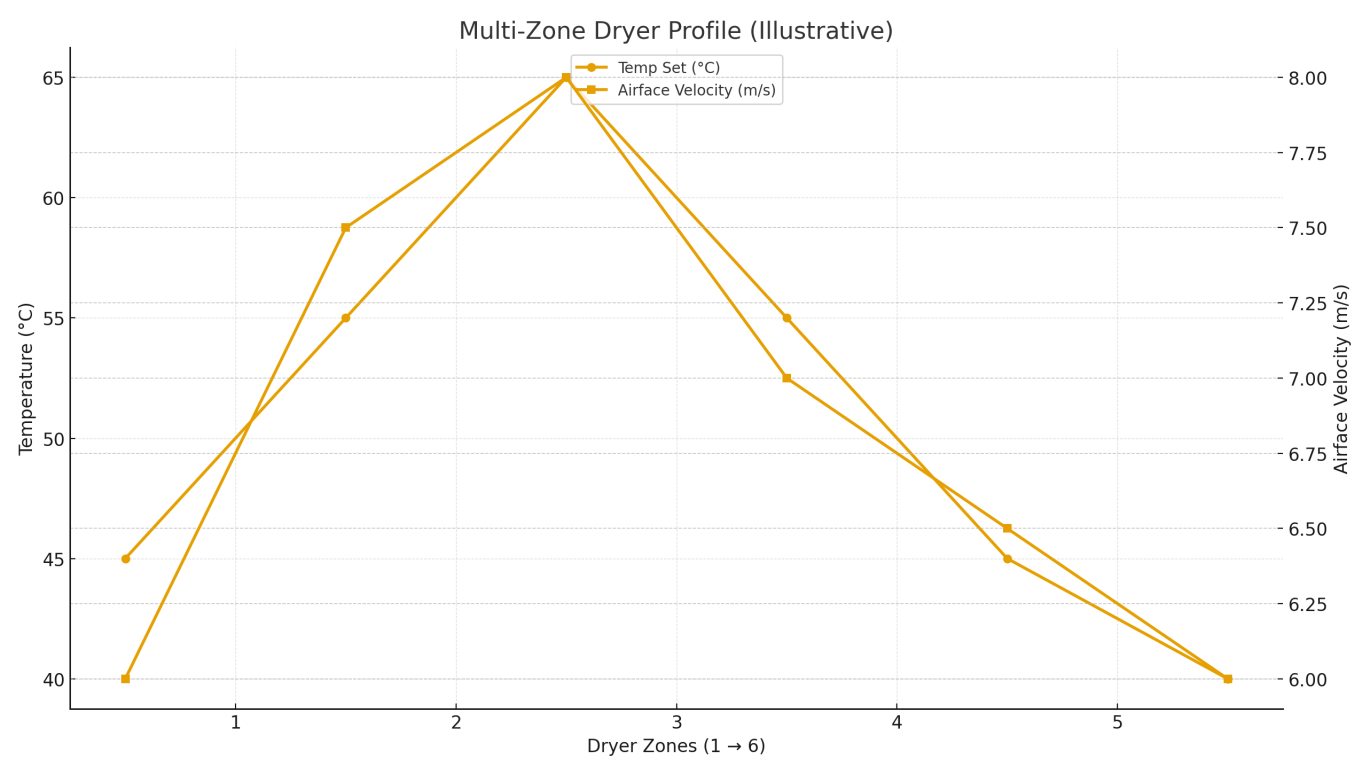
Figure 1 shows a six-zone profile with mid-dryer peak temperature and elevated face velocity in Z2–Z4. This pattern supports capillary leveling before skin-over, then drives bulk solvent removal, followed by tapering to reduce thermal stress before winding. [2–5]
Moisture removal kinetics
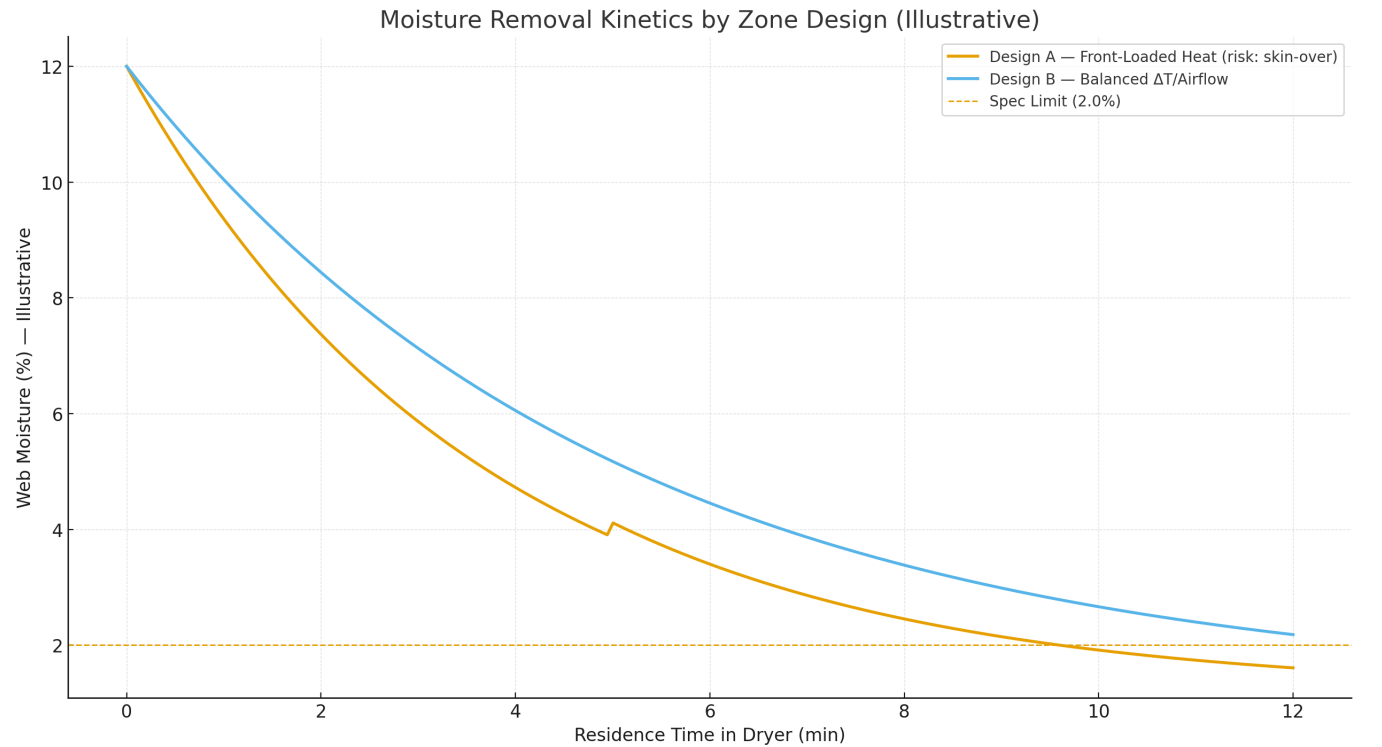
Figure 2 compares Design A vs B. Front-loaded heat (A) removes moisture quickly at first, but shows a late-stage tail (skin-over penalty), risking >2% exit-moisture at the same residence. The balanced design (B) achieves smoother exponential decay and meets a 2.0% spec with margin, improving curl and blocking outcomes. [3–6]
Defect risk vs exit moisture & conditioning
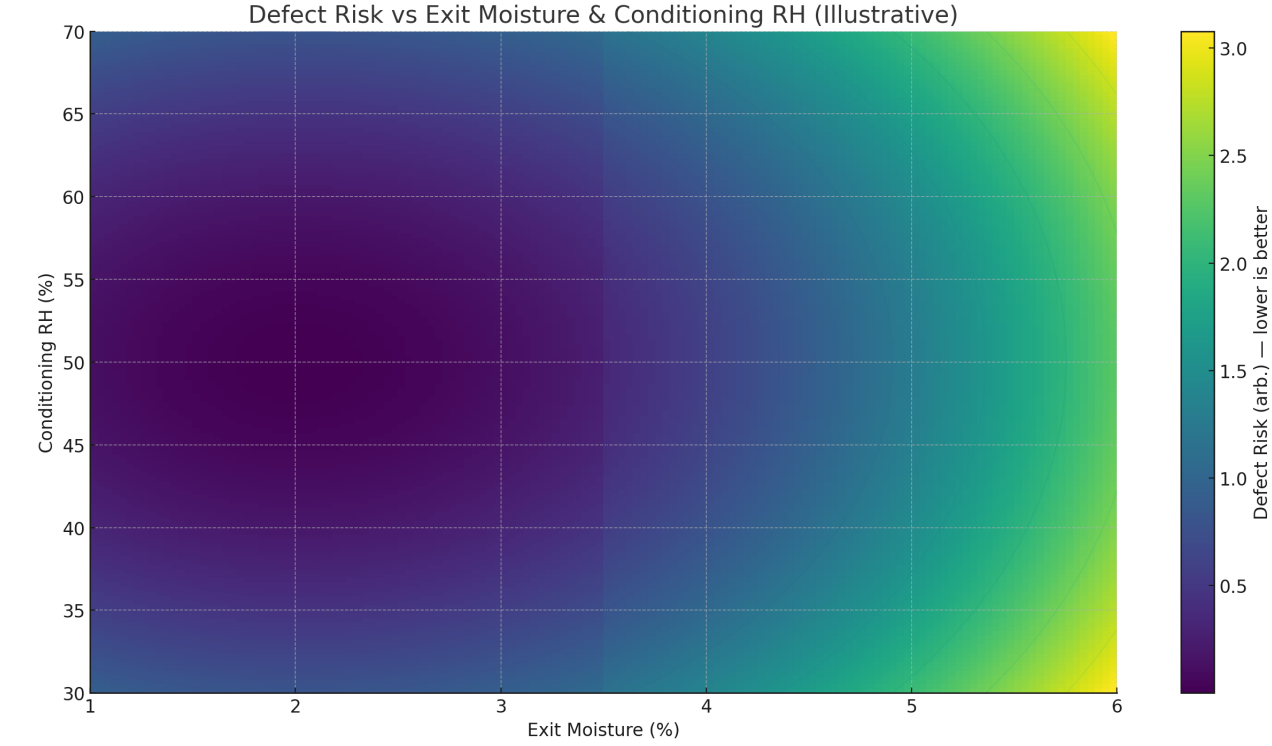
Figure 3 maps a defect-risk surface: risk is minimized around exit moisture ≈ 1.6–2.4% and conditioning RH ≈ 45–55%. Higher exit moisture and high RH drive curl/blocking; too-dry films at very low RH can become brittle and raise seal opening-force variance. [5–8]
Discussion
Design principles
Dry to the core, not just the skin. Favor balanced ΔT with sufficient impingement to move the solvent front inward; avoid early crusting that stalls diffusion.
Equalize late. A mild final zone or short post-heat equalization reduces thermal gradients and internal stress.
Condition with intent. Set a residual-moisture window and RH/time that minimize curl and maintain pouch sealability; co-own the spec with packaging.
Instrument before speed. Align inline–lab moisture bias; maintain SPC/EWMA on exit moisture and seal metrics; implement historian alarms. [4–8]
Common pitfalls
Tuning dryers by outlet temperature only; neglecting face velocity and nozzle balance.
Pushing throughput by raising web speed without re-balancing zone residence.
Setting moisture specs without linking to curl/blocking/seal outcomes.
Deferring packaging validation (seal window) until after line speedups. [3–6,8]
Conclusion
ODF quality is written inside the dryer. A zone design that couples moderate staged ΔT with controlled airflow and defined exit-moisture/conditioning windows yields flat, uniform, pouch-ready films and fewer downstream rejects. Embedding PAT and SPC turns this physics into predictable, audit-ready production.
References
Capacity/OEE modeling and validation overlap for continuous lines.
Heat/mass transfer in thin wet films and capillary-leveling interactions.
Multi-zone dryer design: ΔT, impingement velocity, residence optimization.
QbD/PAT for coating: inline thickness/moisture/vision, historian, GR&R, ALCOA+.
Moisture–curl–blocking relationships and conditioning strategies.
Exit-moisture SPC and Western-Electric rules for stable release.
Packaging integration: seal window (T/P/dwell) and opening-force windows.
Laminate barrier selection (OTR/WVTR) vs residual moisture and shelf stability.