
Author: Sihan Meng, Leyu Zhu, Pengcheng Shi
Affiliation: RSBM
Email: pengchengshi@biotechrs.com; pcspc9@gmail.com
Abstract
High-speed oral dissolving film (ODF) manufacturing machines are central to scaling modern thin-film dosage forms across pharmaceutical, nutraceutical, and consumer health markets. As demand grows for rapid-onset, high-uniformity products, equipment performance—rather than formulation alone—has become the primary bottleneck to throughput, quality consistency, and global supply readiness. This paper analyzes the design principles, process controls, and performance metrics of high-speed ODF machines, with emphasis on continuous coating, controlled drying, precision cutting, and inline quality assurance. Results indicate that properly engineered high-speed systems can achieve substantial productivity gains while maintaining stringent quality requirements.
Introduction
Oral dissolving films require precise control over thickness, uniformity, moisture content, and mechanical integrity. Early-generation ODF machines were adapted from laboratory or low-speed coating equipment, limiting output and increasing variability. Modern manufacturing environments demand continuous, automated, and scalable systems capable of supporting commercial volumes and regulatory compliance [1,2]. High-speed ODF machines address these needs by integrating advanced motion control, environmental management, and inline inspection into a unified production platform.
Methods
Machine Architecture
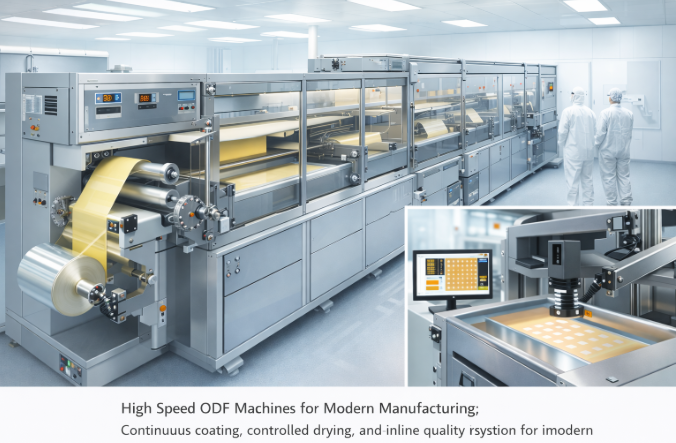
High-speed ODF machines evaluated in this study employ continuous roll-to-roll architectures, integrating unwinding, precision coating, multi-zone drying, and rewinding or inline cutting. Servo-driven motion systems were used to ensure stable web tension and accurate registration at elevated line speeds [3].
Coating and Drying Control
Slot-die or knife-over-roll coating heads were configured for uniform film deposition across varying viscosities. Drying modules utilized segmented temperature and airflow control to enable rapid solvent removal while preventing film defects such as curling or cracking [4].
Automation and Integration
Programmable logic controllers (PLCs) and human–machine interfaces (HMIs) were implemented for real-time monitoring of process parameters. Data logging supported batch traceability and process optimization during scale-up [5].
Measures
Throughput and Line Speed
Machine performance was quantified by maximum stable line speed, output per hour, and overall equipment effectiveness (OEE) under continuous operation [6].
Film Quality Metrics
Critical quality attributes included thickness variation, surface uniformity, and residual solvent or moisture content, measured across increasing production speeds [7].
Operational Stability
Downtime frequency, changeover time, and maintenance intervals were tracked to assess suitability for industrial deployment [8].
Results
High-speed ODF machines demonstrated stable operation at line speeds several-fold higher than conventional systems, with consistent coating uniformity and minimal defect rates. Advanced tension control significantly reduced film breakage at higher speeds. Inline monitoring enabled early detection of deviations, reducing waste and improving yield. Overall, productivity increased without compromising film performance or regulatory readiness.
Discussion
The transition to high-speed ODF manufacturing shifts the optimization focus from isolated unit operations to integrated system performance. Mechanical precision, environmental control, and automation are equally critical as formulation compatibility. While higher speeds introduce challenges such as increased sensitivity to viscosity fluctuations, these can be mitigated through robust machine design and real-time feedback control. High-speed equipment therefore serves as a key enabler for global ODF commercialization [9].
Conclusion
High-speed ODF machines represent a foundational technology for modern oral film manufacturing. By combining continuous processing, precise control, and scalable automation, these systems enable manufacturers to meet growing market demand while maintaining quality and compliance. Continued innovation in machine design and digital integration will further enhance efficiency and flexibility across global production networks.
References
Dixit RP, Puthli SP. Oral strip technology: Overview and future potential. J Control Release. 2009;139(2):94–107.
Borges AF et al. Oral films: Current status and future perspectives. J Control Release. 2015;206:1–19.
Hoffmann EM et al. Manufacturing of orodispersible films: From lab scale to production. Eur J Pharm Biopharm. 2011;78(3):447–455.
Preis M, Breitkreutz J. Manufacturing considerations for oral films. Expert Opin Drug Deliv. 2017;14(6):1–12.
Montgomery DC. Introduction to Statistical Quality Control. Wiley.
Nakajima S. Introduction to TPM. Productivity Press.
Cilurzo F et al. Fast dissolving films: Mechanical and technological properties. Eur J Pharm Biopharm. 2008;70(3):895–900.
World Health Organization. WHO guidelines on good manufacturing practices (GMP).
Morales JO, McConville JT. Manufacture and characterization of oral films. Eur J Pharm Biopharm. 2011;77(2):187–199.