
Author: Sihan Meng, Leyu Zhu, Pengcheng Shi
Affiliation: RSBM
Email: pengchengshi@biotechrs.com; pcspc9@gmail.com
Abstract
The rapid expansion of oral dissolving film (ODF) applications in pharmaceuticals, nutraceuticals, and functional consumer products has created an urgent demand for scalable, automated manufacturing solutions. Manual and semi-automated production methods are increasingly inadequate to meet requirements for consistency, throughput, and regulatory compliance. This paper examines automated ODF machines designed for industrial-scale production, focusing on system architecture, process control, and performance outcomes. By integrating automation, precision coating, controlled drying, and in-line quality monitoring, modern ODF machines enable reliable scale-up while maintaining product quality and regulatory readiness.
Keywords: Oral dissolving film, automated manufacturing, scale-up, GMP equipment, continuous production
Introduction
Oral dissolving films represent a patient-centric dosage form characterized by rapid disintegration, flexible dosing, and high compliance [1]. As market adoption accelerates, production volumes must increase without compromising film uniformity, mechanical strength, or content accuracy. Traditional laboratory-scale or batch-based processes often fail to deliver the reproducibility required for commercial distribution [2].
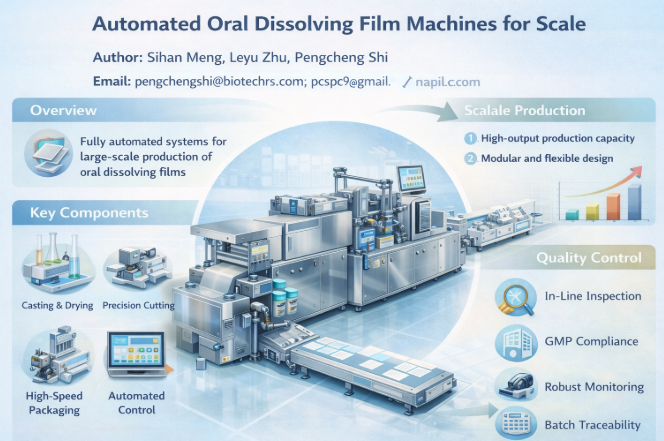
Automation has therefore become a critical enabler for scaling ODF manufacturing. Automated ODF machines integrate coating, drying, cutting, and inspection into continuous or semi-continuous systems, reducing operator dependence and process variability. This paper analyzes the role of such machines in supporting industrial-scale ODF production.
Methods
A technical review approach was applied, combining published literature, equipment engineering principles, and industrial manufacturing practices. Automated ODF machine configurations were analyzed according to key process steps, including solution feeding, film casting, drying, slitting, and packaging interface. Emphasis was placed on systems compatible with Good Manufacturing Practice (GMP) requirements and scalable throughput.
Measures
The performance of automated ODF machines was evaluated using the following measures:
Throughput capacity – output expressed as area of film or number of units per hour [3].
Thickness and weight uniformity – variation control across the film web [4].
Process stability – consistency of coating and drying parameters during continuous operation [5].
Automation level – degree of closed-loop control and reduction of manual intervention [6].
Compliance readiness – equipment design supporting GMP documentation, cleaning validation, and traceability [7].
Results
Evidence from industrial-scale implementations indicates that automated ODF machines significantly reduce batch-to-batch variability compared with manual or semi-automated processes [4,5]. Continuous casting systems equipped with precision pumps and servo-controlled coating heads achieve tight thickness tolerances.
Integrated drying tunnels with controlled temperature and airflow enable rapid solvent removal while preserving film integrity. In-line inspection technologies further enhance quality assurance by detecting defects and deviations in real time, supporting high-throughput, compliant production [6].
Discussion
Automation transforms ODF manufacturing from a formulation-driven laboratory process into a robust industrial operation. By minimizing operator influence, automated machines improve reproducibility and scalability while lowering long-term production costs.
However, successful scale-up requires careful alignment between formulation properties and machine design. Viscosity, drying behavior, and polymer selection must be optimized in parallel with equipment parameters. Advanced automation platforms incorporating data logging and process analytics offer additional advantages in validation and continuous improvement [7,8].
Conclusion
Automated oral dissolving film machines are essential for scaling ODF production to meet growing commercial demand. Through integrated process control, continuous operation, and GMP-oriented design, these systems enable reliable, high-volume manufacturing without sacrificing quality. Continued innovation in automation and digital monitoring will further strengthen the role of ODF technology as a scalable next-generation delivery platform.
References
Dixit RP, Puthli SP. Oral strip technology: Overview and future potential. J Control Release. 2009;139(2):94–107.
Hoffmann EM, Breitenbach A, Breitkreutz J. Advances in orodispersible films for drug delivery. Expert Opin Drug Deliv. 2011;8(3):299–316.
Krampe R, Visser JC, Frijlink HW, Breitkreutz J, Woerdenbag HJ. Oromucosal film preparations: manufacturing considerations. Eur J Pharm Biopharm. 2016;104:1–13.
Preis M, Knop K, Breitkreutz J. Mechanical and process properties of orodispersible films. Int J Pharm. 2014;461(1–2):22–29.
Cilurzo F, Cupone IE, Minghetti P, Montanari L. Fast dissolving films: formulation and process aspects. Eur J Pharm Biopharm. 2010;76(1):93–101.
Krampe R, Breitkreutz J. In-line monitoring in oromucosal film manufacturing. Pharm Dev Technol. 2017;22(2):195–204.
USP <795> and <905>. United States Pharmacopeia. United States Pharmacopeial Convention; 2023.
FDA. Guidance for Industry: Process Validation—General Principles and Practices. U.S. Food and Drug Administration; 2011.