
Author: Sihan Meng,Leyu Zhu,Pengcheng Shi
Affiliation: RSBM
Email: pengchengshi@biotechrs.com; pcspc9@gmail.com
Abstract
Choosing the right oral dissolving film (ODF) machine in 2025 requires aligning throughput targets, coating/drying precision, and packaging readiness with realistic total cost of ownership (TCO). This guide benchmarks lab, pilot, and 24/7 commercial lines across capability, scale economics, and layout building blocks. We share a methods framework and measurable indicators—CPP→CQA mapping, capability (Cp/Cpk), OEE, and changeover time—and present three figures: a capability matrix, TCO vs. throughput curve, and a typical line layout. Results show that buyers should prioritize closed-loop tension, inline thickness/moisture gauges, multi-zone drying, and packaging integration to convert nameplate speed into sustained good-meters. [1–7]
Introduction
ODF production is a roll-to-roll (R2R) discipline where small drifts in rheology, bead stability, tension, and drying balance cascade into defects, curl, and packaging rejects. Buyers face a spectrum of machines—from benchtop lab coaters to fully automated 24/7 lines. The core question is not only “how fast,” but “how controllably fast,” with PAT (process analytical technology) and packaging compatibility as decisive differentiators. [2–5]
Methods
Use-case scoping: Define target dose (mg/cm²), film thickness (µm), width (mm), and daily good-product output (kg/day).
CPP→CQA mapping: Link coat weight, gap, speed, tension σ, and drying ΔT/airflow to thickness CV%, disintegration, residual moisture, and seal pass rate. [2–4]
Instrumentation audit: Require inline thickness and moisture, vision inspection, closed-loop tension, and zone-by-zone drying telemetry with audit-ready data integrity (ALCOA+). [3–5]
Scale path: Validate on lab → pilot → commercial with recipe portability (identical head geometry where possible).
Economics: Model TCO/1,000 doses vs throughput (utilities, scrap, labor, materials, planned OEE).
Verification: Request FAT/SAT with GR&R and SPC baselines; include RH cycling and peel-force windows for packaging. [4–7]
Measures
Quality: thickness CV% and cross-web P–V (µm); Cp/Cpk for thickness ≥1.33; residual moisture (%) at exit; disintegration (s).
Process health: SPC/EWMA violations, alarm MTTR, web breaks per 10k m.
Operations: OEE (%), good-meters/min, changeover (min), scrap (%), unplanned downtime (h/mo).
Packaging: seal strength (N/15 mm), opening-force window, OTR/WVTR fitness. [3–7]
Results
Capability by Scale
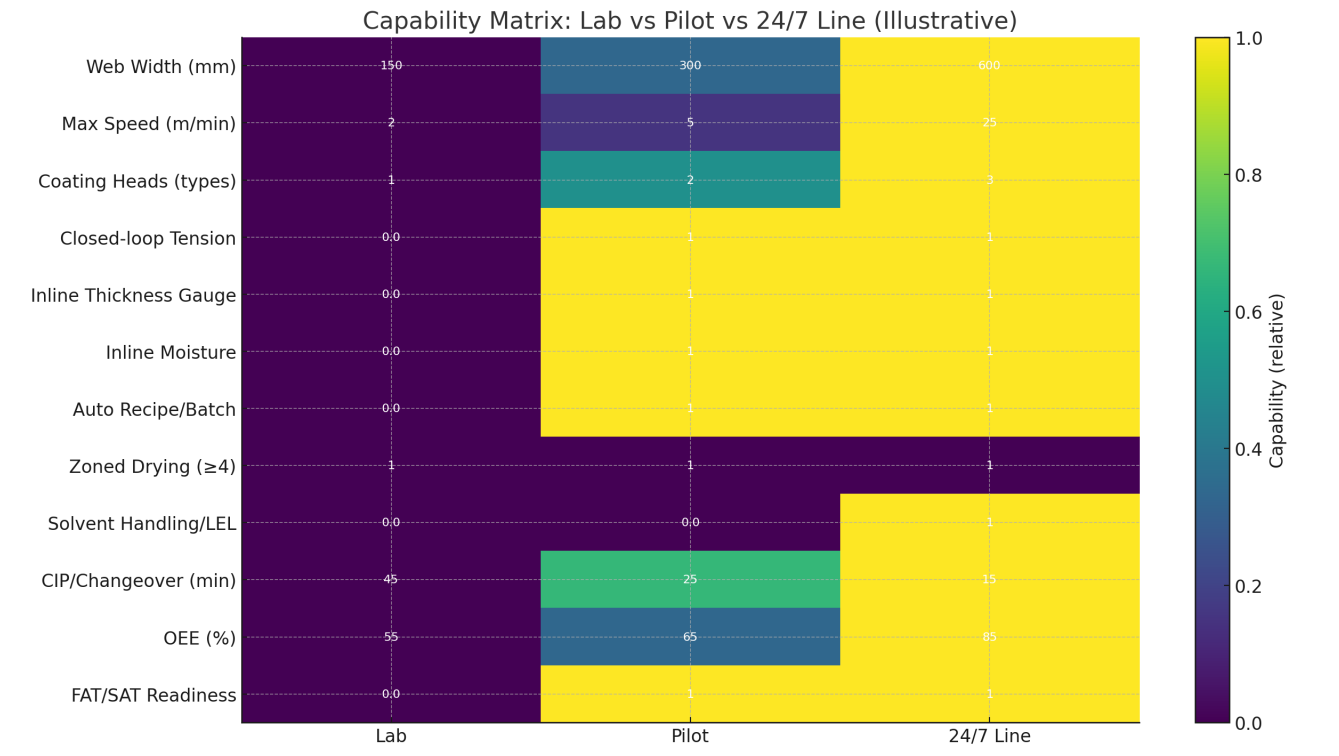
Figure 1 compares lab, pilot, and 24/7 lines. Moving to 24/7 capability requires not just higher web width and speed, but also closed-loop tension, inline thickness/moisture, robust auto-recipe/batch, and solvent/LEL management. CIP/changeover time and OEE typically improve with integrated automation. [3–6]
Economies of Scale
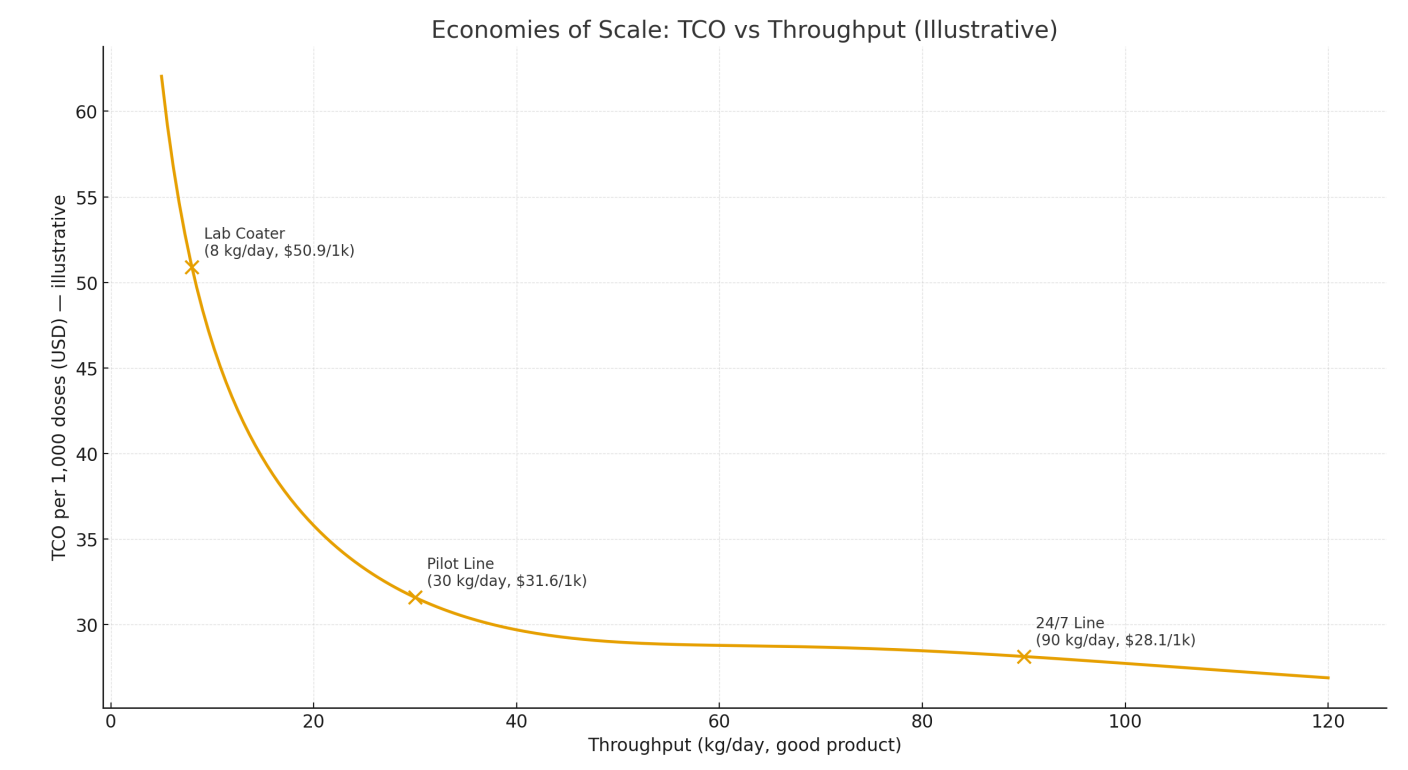
Figure 2 shows an illustrative TCO vs throughput curve: TCO per 1,000 doses declines with scale until utilities and labor flatten the gains. Example anchor points (lab, pilot, commercial) highlight where buyers often see step-changes in cost and capability; undersizing invites overtime and scrap, oversizing bloats capex and under-utilization. [1,6–7]
Typical Line Layout
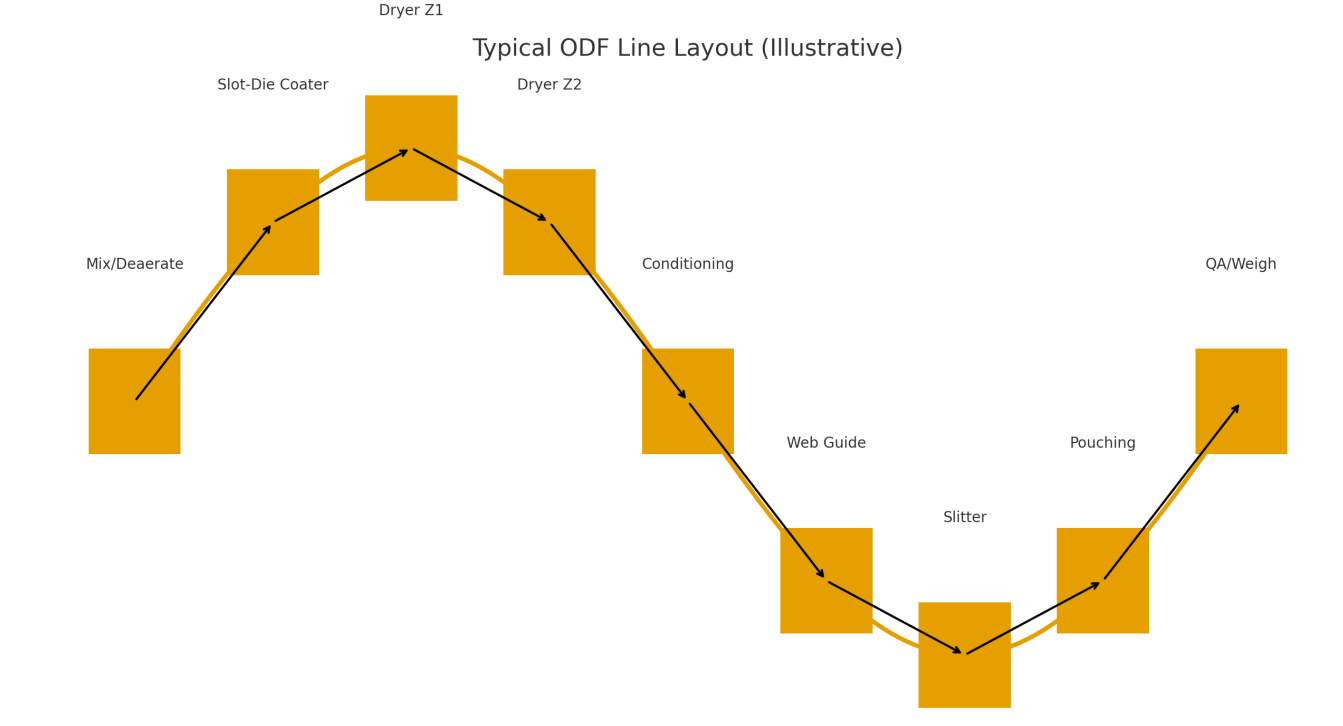
Figure 3 depicts a common layout: Mix/Deaerate → Slot-Die Coater → Dryer Z1/Z2 → Conditioning → Web Guide → Slitter → Pouching → QA/Weigh. Maintaining bead stability and cross-web uniformity upstream is the best predictor of downstream seal pass rate and field performance. [2–5]
Discussion
1) Lab vs Pilot vs Production—what to buy now.
Lab coaters: ideal for formulation DoE and early PAT, but limited in web control and drying power; use identical die geometry to de-risk scale-up.
Pilot lines: bridge to commercial; must include closed-loop tension and inline thickness to prove Cpk and recipe portability.
24/7 lines: emphasize uptime, redundancy (spares, quick-swap lips), and environmental robustness (RH/temperature). [3–6]
2) Must-have options in 2025.
Closed-loop tension with fast step response (≤3 s).
Inline thickness + moisture gauges with proven GR&R.
Multi-zone drying (≥4) with balanced ΔT/air and exhaust/LEL control.
Auto recipe/batch, historian, and ALCOA+ data integrity for audits.
Packaging integration (sachet/blister), validated peel-force window, and easy-tear consistency. [3–5]
3) Hidden traps.
Buying on speed alone; lacking PAT means speed amplifies scrap.
Mismatched packaging line (seal dwell/temp) causing false rejects.
Ignoring utility and HVAC load; drying under-supply creates curl/residuals.
No solvent/LEL architecture for future SKUs. [4–7]
Conclusion
For 2025 buyers, the winning ODF machine is not just faster—it is measurably controllable and packaging-ready. Specify closed-loop tension, inline thickness & moisture, multi-zone drying, and recipe portability from lab to pilot to commercial. Require FAT/SAT with capability indices and packaging windows. This approach translates nameplate speed into stable good-meters, lower TCO, and faster compliant launches.
References
ODF market scaling and capex planning—industry outlooks and benchmarking reports.
Coating/web handling fundamentals for thin films: slot-die/comma, bead pressure, tension loops.
QbD/PAT for continuous film lines: inline thickness/moisture/vision and GR&R.
Multi-zone drying design: ΔT/air balance, residence time, and curl/residual control.
Packaging integration: seal windows, opening-force metrics, and barrier (OTR/WVTR).
OEE, changeover strategy, and maintenance best practices for R2R systems.
TCO modeling for pharmaceutical/nutraceutical continuous processes.