
Author: Sihan Meng,Leyu Zhu,Pengcheng Shi
Affiliation: RSBM
Email: pengchengshi@biotechrs.com; pcspc9@gmail.com
Abstract
Selecting an orally disintegrating film (ODF/OTF) machine is often complicated by marketing claims that obscure real, production-critical capabilities. This guide distills selection to three key parameters—drying capacity, tension control, and coating uniformity—that together determine throughput, yield, and lifetime cost. Using a structured evaluation method, measurable indicators, and illustrative benchmarking, we show how these parameters link to scrap rate, energy consumption, and total cost of ownership (TCO). Practical results and discussion highlight common purchasing traps (e.g., nameplate speed vs. usable speed; “lab-only” coater heads; under-specified drying zones) and propose quantitative acceptance criteria to de-risk procurement. [1–6]
Introduction
ODF manufacturing is a continuous R2R process—casting/coating, drying, conditioning, slitting, unit-dose packaging—where machine capability must align with a validated formulation and quality targets (CQAs such as thickness, uniformity, disintegration, residual solvent/water). While vendors emphasize maximum speed, the true constraint is the steady-state window set by drying energy transfer, web tension stability, and coating head precision. Failure to verify these leads to chronic defects (necking, wrinkles, pinholes, thickness bands), high scrap, and a costlier line than advertised. [2–6]
Methods
Parameter selection. From process hazard analysis (PHA) and QbD mapping, we prioritized three machine-side CPP clusters:
Drying capacity (kW and kWh/m², zoned temperature/airflow, solvent handling).
Tension control (closed-loop tension range/resolution, sensor type/placement, dancer/servo integration).
Coating uniformity (head type, lip/edge control, profile correction, ±µm at target thickness). [2–4]
Test protocol. Factory Acceptance Test (FAT) matrix with filmable surrogate inks (viscosity ladder), 60–120 µm wet thickness setpoints, and step responses in speed, temperature, and tension; capture time-series for CV% and web defects.
Economics model. Link parameter performance to scrap rate, energy use, and OEE, then to 5-year TCO (CapEx + energy + consumables + maintenance + downtime).
Visualization. Three figures: parameter radar, stacked-bar TCO, and throughput–scrap scatter with energy bubbles.
Measures
Drying capacity: zonal kW, ΔT stability (± °C), residence time at target speed, exhaust LEL margin, residual solvent/water at exit.
Tension control: steady-state σ drift (N, ±%), step-disturbance recovery time (s), wrinkle index, edge wander (mm).
Coating uniformity: cross-web thickness P–V (µm), CV%, streak/band defect counts per 100 m.
Line economics: good-meters/min, scrap %, kWh/hr, changeover minutes, unplanned downtime hr/month, 5-year TCO.
Results
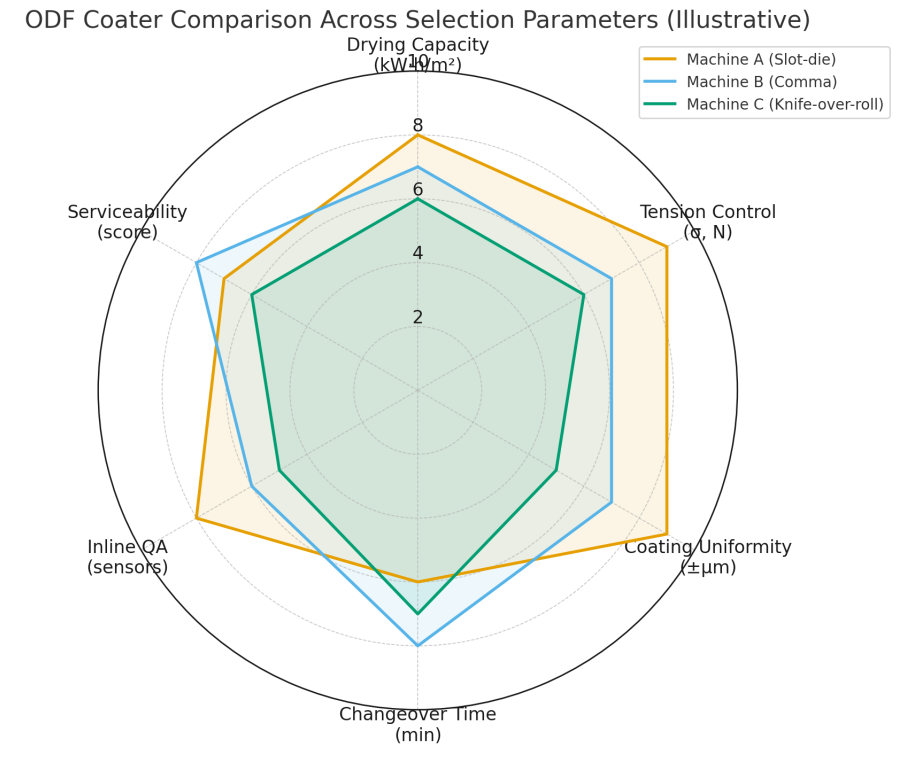
1) Parameter radar (Figure 1). “Machine A (slot-die)” scores highest on drying, tension, and uniformity; “Machine B (comma)” is balanced with fast changeover; “Machine C (knife-over-roll)” trails in uniformity, suitable for thicker films or non-critical SKUs.
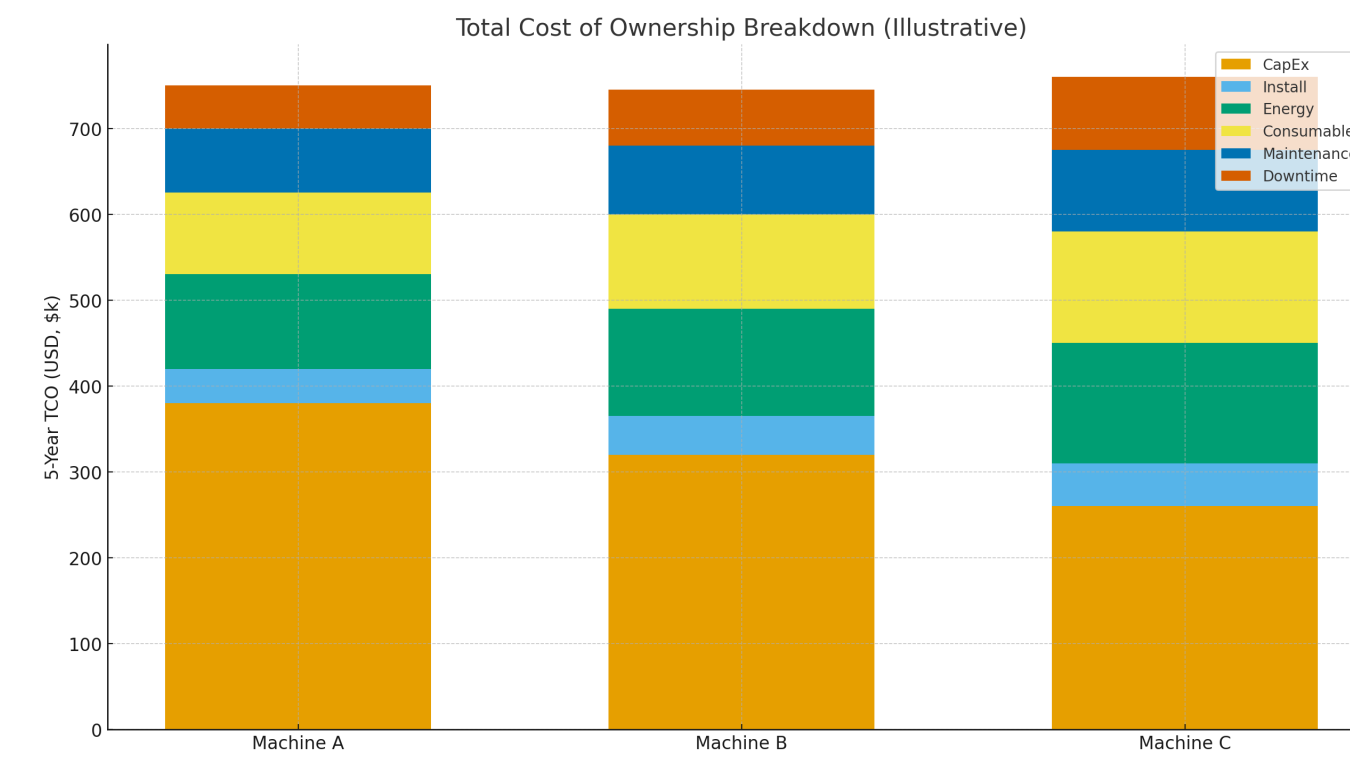
2) TCO comparison (Figure 2). Although Machine A has higher CapEx, it achieves lower energy, consumables, and downtime costs by enabling higher usable speed and lower scrap—resulting in competitive 5-year TCO.
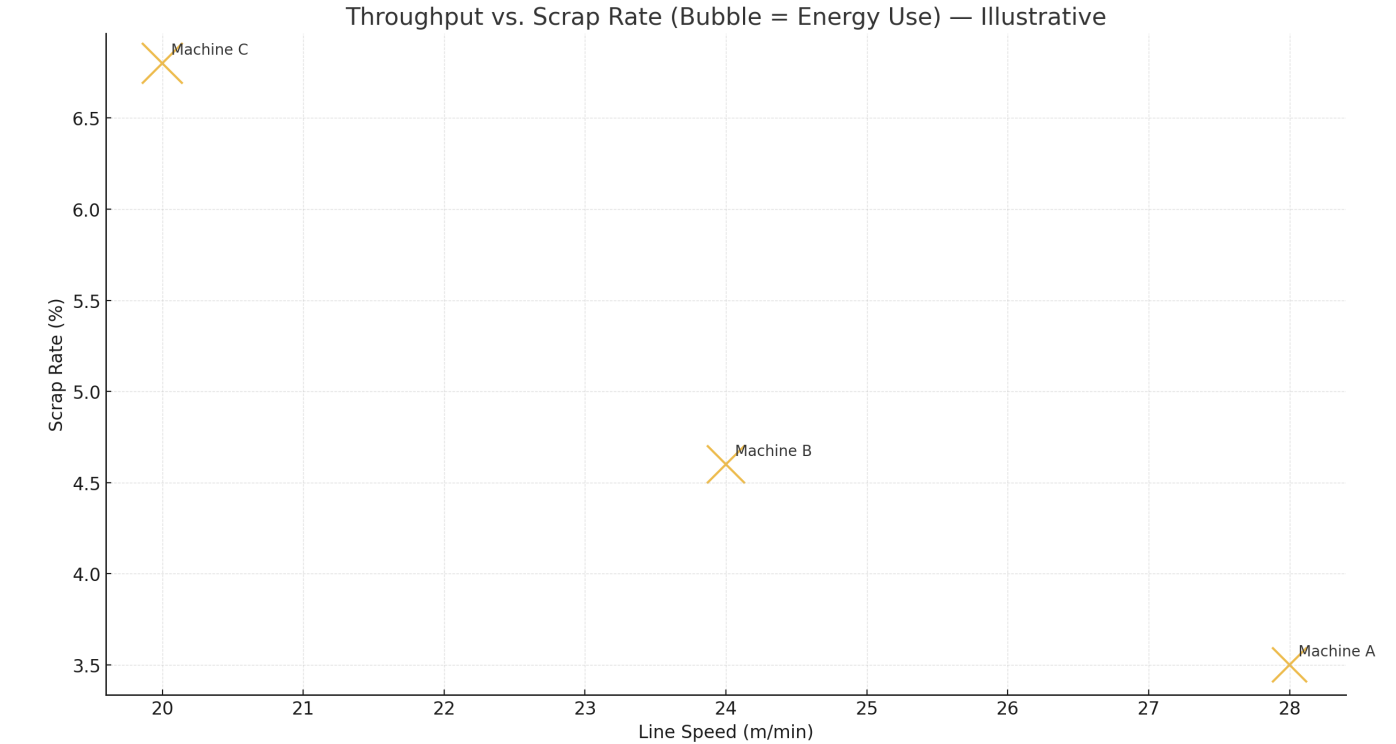
3) Throughput vs scrap (Figure 3). Usable speed (good-meters) is limited by scrap escalation when drying/tension/uniformity fall outside control. Machine A sustains ~28 m/min at ~3.5% scrap; Machine C reaches ~20 m/min at ~6.8% scrap with higher energy intensity.
Discussion
Three Key Parameters—and the Traps They Reveal
Drying Capacity (the hidden bottleneck).
What to verify: zoned kW, airflow uniformity, residence time at target speed/thickness, residuals at exit, LEL monitoring.
Trap: nameplate “max speed” quoted at minimal wet thickness or with unrealistically hot setpoints—not your validated recipe. Require residual solvent/water data at your target film. [2–3,5]
Tension Control (defect amplifier).
What to verify: closed-loop tension range/resolution, sensor placement before/after dryer, response to step changes (ramp speed ±10%).
Trap: open-loop or single-zone control that looks fine during demo but drifts during long runs, causing wrinkles/edge wander and slit width scatter. [3–4]
Coating Uniformity (yield governor).
What to verify: head type (slot-die vs comma vs KOR), lip alignment, edge-bead management, profile correction, ±µm tolerances across web.
Trap: lab demo with narrow web or benign ink; production width exposes cross-web bands. Demand full-width gauge maps and Cpk at your thickness. [4–6]
Acceptance Criteria (suggested)
Residuals at exit: ≤ target (e.g., solvent < X ppm; water < Y %).
Thickness uniformity: cross-web P–V ≤ ±5–10 µm at 60–100 µm dry; CV% ≤ 2–3%.
Tension stability: drift ≤ ±2% over 30 min; step disturbance recovery ≤ 3 s; zero persistent wrinkles.
Energy: ≤ kWh per good-meter benchmark for your solvent/water system.
Changeover: head clean/prime ≤ 45–60 min; recipe swap ≤ 15 min with logged parameters.
Procurement Checklist
FAT with your surrogate/coating; export raw time-series.
Inline gauge (thickness/defect) provisioned for CQAs; PAT ports available.
Dryer exhaust/solvent safety; interlocks and data integrity.
Slitter/rewinder integration; sachet/blister interface specs.
Spares and service SLAs; remote diagnostics; training scope.
Conclusion
Avoiding ODF machine purchasing traps hinges on instrumented verification of drying capacity, tension control, and coating uniformity under your recipe and target speed. These parameters directly drive scrap, energy, and uptime—dominating 5-year TCO far more than nameplate speed or headline CapEx. A disciplined FAT protocol, quantitative acceptance criteria, and lifecycle-service provisions convert procurement risk into predictable performance.
References
Roll-to-roll coating and drying fundamentals for pharmaceutical films—overview of heat/mass transfer and residence-time design.
Slot-die vs comma vs knife-over-roll for thin-film uniformity—comparative process reviews.
Web handling and tension control in continuous coating—closed-loop strategies and defect mechanisms.
ODF quality by design (QbD) and critical quality attributes (CQAs): thickness, residuals, disintegration, mechanical integrity.
Process analytical technology (PAT) for film lines: inline thickness and defect inspection; moisture/solvent sensors.
Energy and TCO modeling for drying-intensive web processes: speed windows, scrap economics, and downtime costs.