
Author: Sihan Meng,Leyu Zhu,Pengcheng Shi
Affiliation: RSBM
Email: pengchengshi@biotechrs.com; pcspc9@gmail.com
Abstract
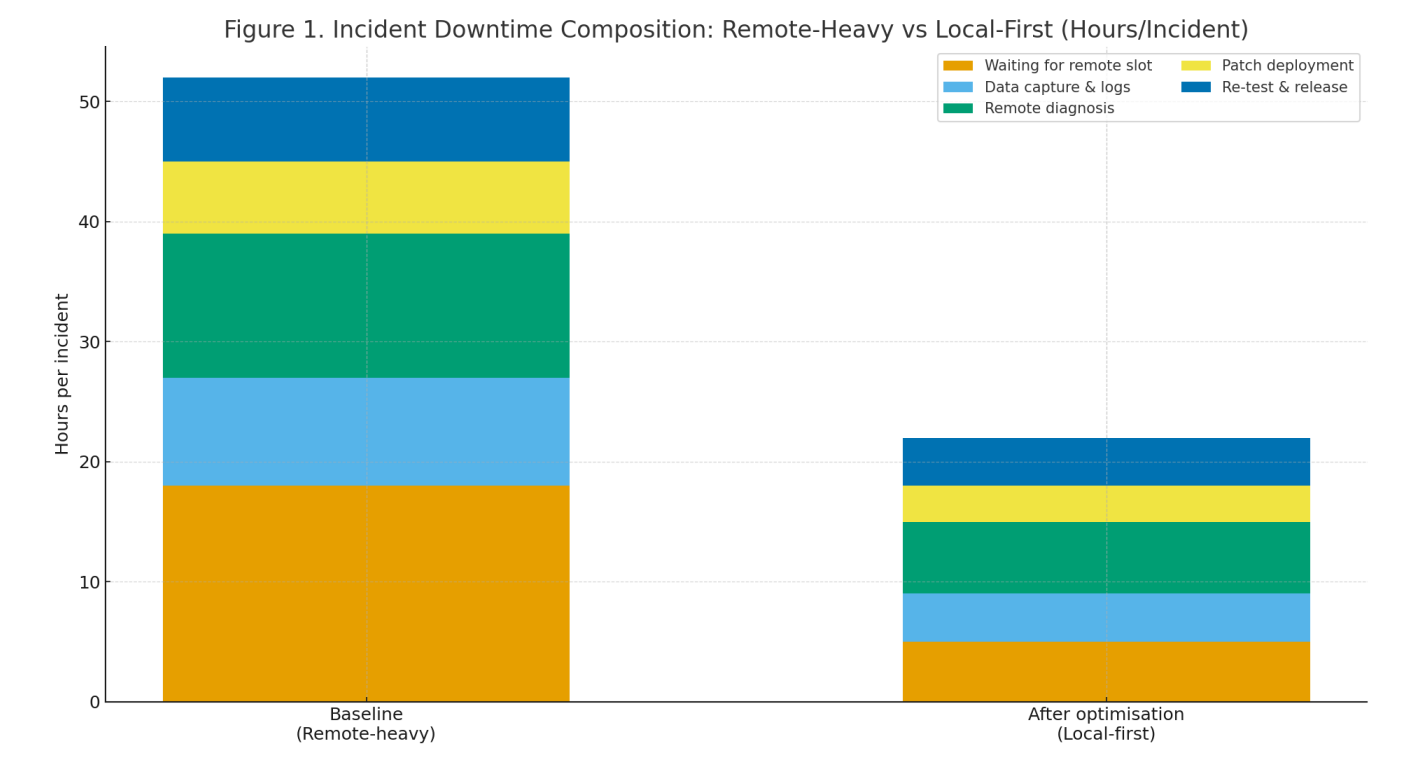
ODF manufacturing lines often rely on vendor remote support for commissioning and troubleshooting. In bandwidth-constrained sites with immature maintenance capabilities, remote debugging elongates downtime and elevates scrap, while skills gaps limit first-time fixes. We quantify the delay drivers, map competency gaps, and propose a hybrid optimisation program—connectivity upgrades, standardised data logging (PAT/alarms), local triage SOPs, spare-parts strategy, and vendor on-call SLAs—paired with targeted skills uplift. In an illustrative deployment, mean downtime per incident fell from 52 h to 22 h, first-hour scrap decreased by ~25%, and on-time release improved by ~8 percentage points. Figures show downtime composition, a skills-gap heatmap, and a 12-week optimisation roadmap [1–7].
Introduction
Remote vendor support is indispensable for complex ODF assets (slot-die, multi-zone dryers, web handling, PLC/HMI, in-line vision/PAT). Yet remote-only models suffer from scheduling latency, poor data capture, and limited authority for on-site adjustments. When local teams lack practical skills, repeated remote cycles extend outages and defer root-cause removal. A hybrid strategy that elevates local capability and streamlines remote collaboration can restore availability and GMP readiness [1–4].
Methods
Current-state assessment: incident logs, alarm histories, and release delays over 6 months; value-stream mapping of a typical “call for help” event.
Delay decomposition: time buckets—waiting for remote slot, data capture, remote diagnosis, patch deployment, re-test—benchmarked pre/post (Figure 1).
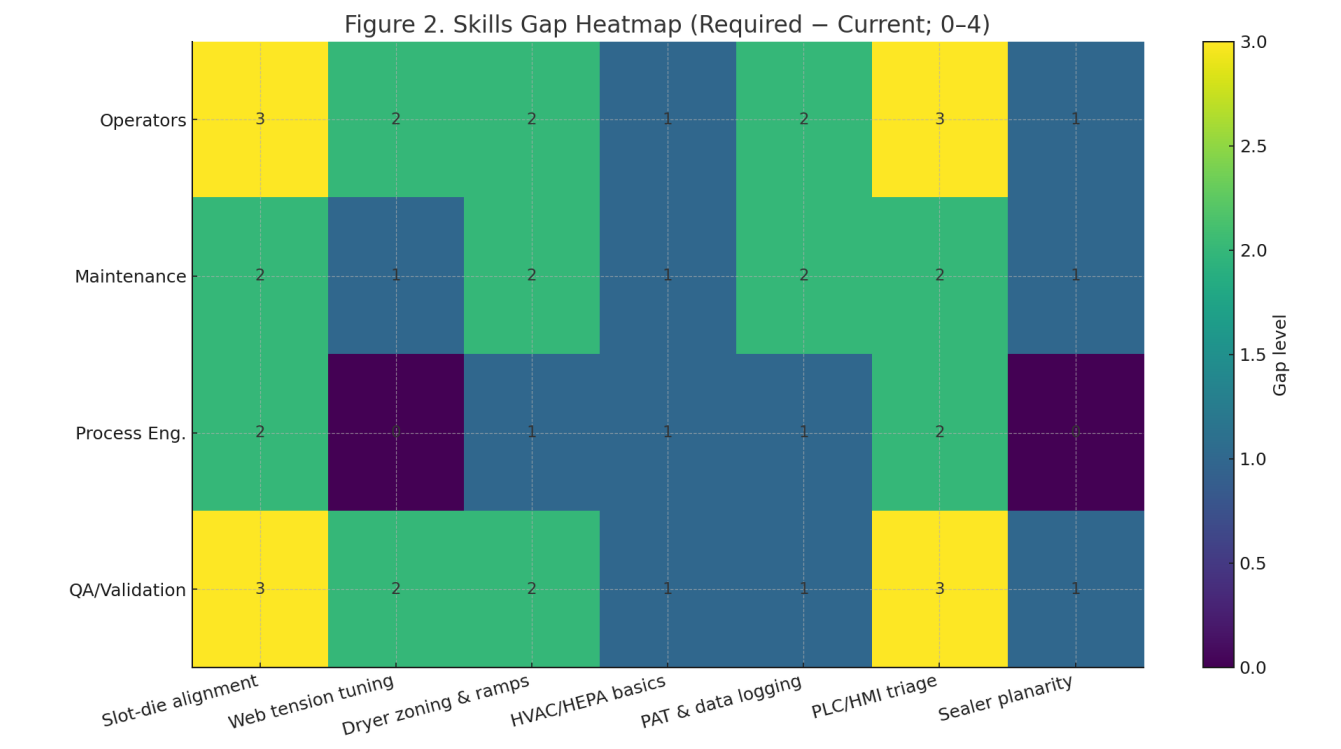
Competency mapping: required proficiency (1–5) vs current for Operators, Maintenance, Process Engineering, QA/Validation across seven competencies; compute gap = required − current (Figure 2).
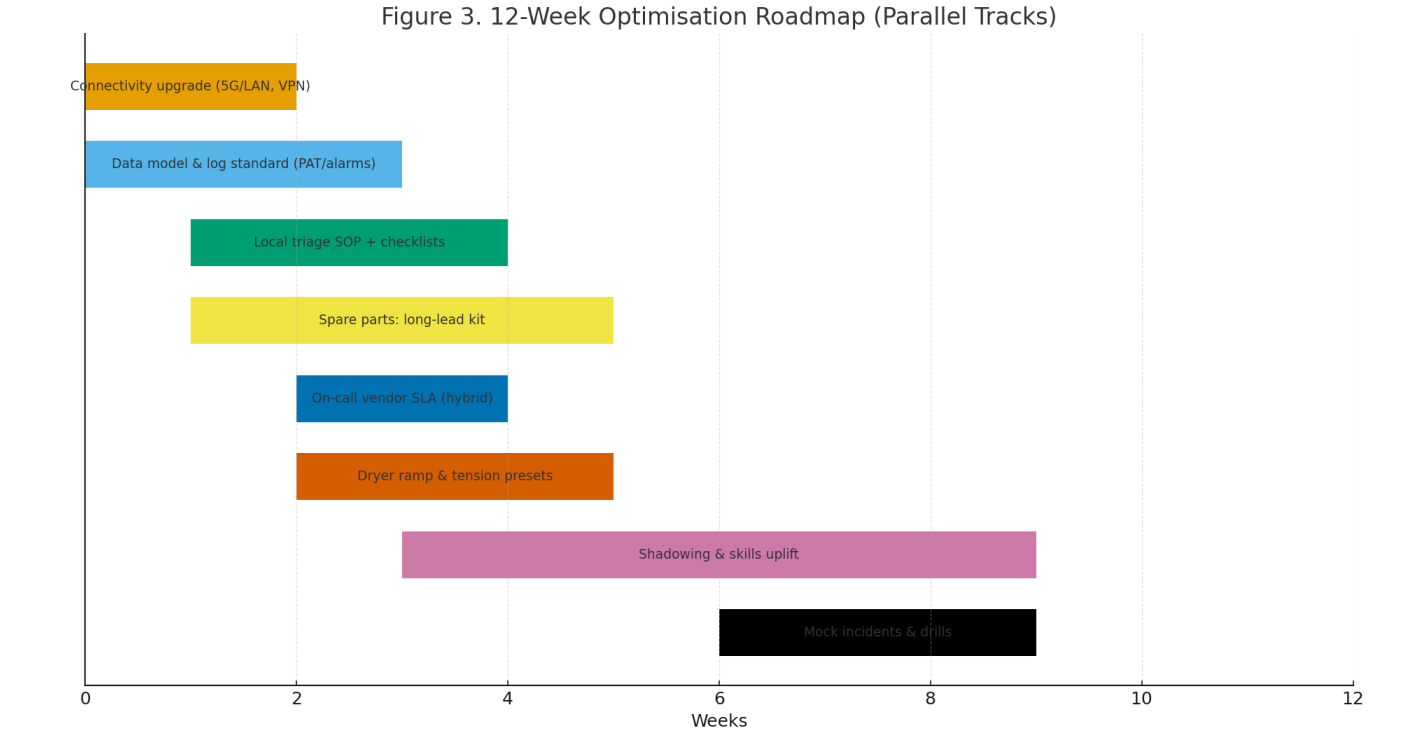
Optimisation bundle: connectivity (5G/LAN + secure VPN), PAT/log standards, local triage SOPs, long-lead spares kit, hybrid SLA (remote + escalation to on-site within 48–72 h), dryer-ramp/tension presets, shadowing & drills (Figure 3).
Measures: MTBF/MTTR, hours/incident, first-hour scrap, deviation density, % on-time disposition, PM compliance, CAPA closure.
Measures
Reliability: MTTR (h), MTBF (h), incidents/1,000 h.
Quality & throughput: first-hour scrap (%), thickness Cpk, release lead time (d).
Process governance: PAT alarm rate per shift, log completeness, % triaged locally.
People & readiness: skills gap index, certification completion, drill pass rate, SLA adherence.
Results
Downtime composition (Fig. 1). Waiting for a remote slot and remote diagnosis accounted for ~58% of baseline hours/incident. With connectivity upgrades, standard logs, and local triage, the same buckets shrank by ~72% and ~50%, respectively; overall hours/incident dropped 52 → 22 (illustrative).
Skills gaps (Fig. 2). Largest gaps appeared in slot-die alignment, PLC/HMI triage, and PAT/data logging for Operators and Maintenance; QA needed uplift around slot-die/planarity to verify fixes.
Operational lift. First-hour scrap decreased ~25%; on-time disposition improved ~8 pp; re-occurrence of identical deviations fell ~40% after introducing dryer-ramp/tension presets and checklists.
Program cadence (Fig. 3). A 12-week roadmap, with overlapping tracks and shadowing/drills, institutionalised the gains; vendor hybrid SLA ensured on-site escalation within 48–72 h.
Discussion
Why remote-only fails. Vendor calendars and back-and-forth log requests elongate outages; limited on-site authority prevents immediate corrective actions. Why hybrid works. Standardised telemetry (PAT tags, alarm codes) plus curated checklists enable local first-time triage; VPN/low-latency links shorten remote cycles; long-lead spares avert waiting waste; shadowing converts “remote instructions” into tacit skill.
Change management. QA/Validation must pre-approve local adjustments (bounded by SOP) and ensure data integrity (ALCOA+) for remote sessions.
Economic view. Connectivity and training are modest capex/opex relative to avoided scrap and lost OEE; typical payback <6 months (scenario).
Limitations. Results are illustrative and depend on polymer/solvent system, climate control maturity, and vendor responsiveness; sites should tailor the skills matrix and SLA.
Conclusion
Time-consuming remote debugging combined with low local capability is a primary driver of excessive ODF downtime. A hybrid optimisation—connectivity + standard logs, local triage SOPs, skills uplift with drills, long-lead spares, and a vendor SLA with on-site escalation—cuts incident hours, stabilises quality, and accelerates release while staying audit-ready.
References
[1] ICH Q10: Pharmaceutical Quality System—roles, responsibilities, and knowledge management.
[2] ISPE/GAMP 5: data integrity, remote access, and computerized systems validation.
[3] EU-GMP Annex 15: qualification/validation and change control expectations.
[4] Maintenance & reliability standards (SMRP/ISO 55000) on MTTR/MTBF and critical spares.
[5] USP/Ph. Eur. chapters for ODF quality and in-process monitoring.
[6] ASTM F1249/F1927 for barrier-linked dryer/HVAC impacts on quality.
[7] Best-practice guides for remote support in regulated environments.