
Author: Sihan Meng, Leyu Zhu, Pengcheng Shi
Affiliation: RSBM
Email: pengchengshi@biotechrs.com; pcspc9@gmail.com
Abstract
Packaging equipment selection plays a decisive role in the cost structure, stability, compliance, and market positioning of oral films, tablets, and other unit-dose products. Among the most commonly used systems, sachet and blister packaging machines represent two distinct technical and commercial philosophies. This paper provides a structured comparison between sachet and blister equipment, focusing on mechanical principles, barrier performance, production efficiency, flexibility, and regulatory considerations. By synthesizing academic literature and industrial practice, the study aims to support manufacturers and brand owners in making rational packaging decisions aligned with product characteristics and commercialization strategies.
Introduction
Packaging is not merely a downstream operation but an integral part of pharmaceutical and nutraceutical product design. For moisture- and oxygen-sensitive dosage forms such as oral dissolving films, packaging selection can determine shelf life and user experience as much as formulation itself [1].
Sachet and blister systems are the two dominant unit-dose packaging technologies in global markets. While both provide individual dose protection, they differ fundamentally in structure, materials, equipment complexity, and cost. Misalignment between product requirements and packaging machinery often leads to excessive costs or insufficient protection. This paper systematically analyzes the differences between sachet and blister equipment to clarify their respective application boundaries.
Methods
A comparative analytical method was adopted. Peer-reviewed publications, pharmacopeial guidance, and industrial technical documents published between 2005 and 2024 were reviewed. Key comparison dimensions were defined in advance: forming principle, packaging materials, barrier performance, line speed, changeover flexibility, capital expenditure, and compliance suitability. Data and qualitative descriptions from the literature were normalized to enable side-by-side comparison [2,3].
Measures
The comparison focused on the following measurable and semi-quantitative indicators:
Barrier performance: moisture vapor transmission rate (MVTR) and oxygen transmission rate (OTR) of typical materials [4].
Production efficiency: nominal packs per minute and overall equipment effectiveness (OEE) [5].
Flexibility: changeover time, format variability, and compatibility with different product sizes [6].
Cost structure: relative capital investment and per-unit packaging cost [7].
Compliance and traceability: suitability for pharmaceutical-grade serialization and batch control [8].
Results
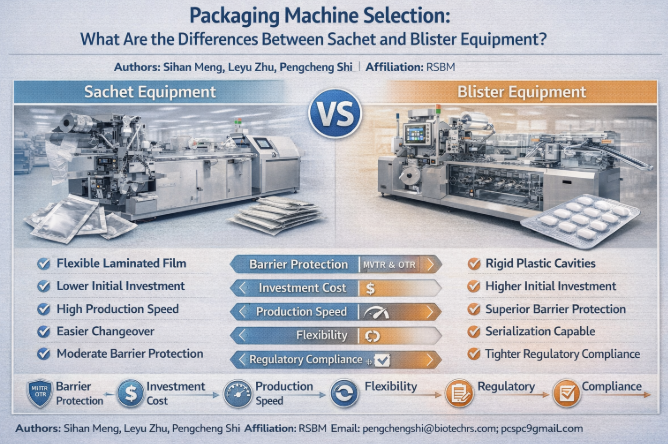
Sachet equipment relies on flexible packaging films formed, filled, and sealed in a continuous or intermittent process. It offers high flexibility and lower initial investment but is limited by the intrinsic barrier properties of laminated films [4].
Blister equipment forms rigid or semi-rigid cavities, typically using PVC, PVDC, or aluminum, followed by lidding and sealing. This structure provides superior moisture and oxygen protection and clear unit-dose visibility, albeit at higher capital and tooling costs [2].
Production speed favors sachet systems for high-volume, low-cost products, whereas blister machines excel in regulated environments requiring stringent stability and traceability [5].
Discussion
The choice between sachet and blister equipment should be driven by product sensitivity, regulatory positioning, and business model rather than by packaging cost alone. Sachet systems are well suited for supplements and consumer products emphasizing flexibility and rapid SKU expansion. In contrast, blister equipment aligns with pharmaceutical or high-value products where stability, tamper evidence, and patient compliance are paramount [6,8].
Importantly, packaging machinery must be evaluated together with upstream manufacturing and downstream distribution. Over-specification can erode margins, while under-specification can compromise quality and market access.
Conclusion
Sachet and blister packaging machines represent complementary rather than competing technologies. Sachet equipment offers flexibility, lower investment, and high throughput, while blister equipment provides superior barrier protection and regulatory robustness. A rational selection requires aligning product properties, market requirements, and long-term scale-up plans. This structured comparison provides a technical foundation for informed decision-making in packaging equipment selection.
References
Aulton ME, Taylor K. Aulton’s Pharmaceutics: The Design and Manufacture of Medicines. 5th ed. Elsevier; 2018.
DeStefano AJ, Hauck WW. Pharmaceutical blister packaging: materials and processes. Pharm Technol. 2005;29(6):52–64.
Felton LA. Mechanisms of polymer film formation. Int J Pharm. 2013;457(2):423–427.
Robertson GL. Food Packaging: Principles and Practice. 3rd ed. CRC Press; 2013.
Shah U, Augsburger LL. Quality by design for packaging operations. AAPS PharmSciTech. 2014;15(2):289–298.
Pilchik R. Validating Medical Packaging. 2nd ed. CRC Press; 2016.
Soroka W. Fundamentals of Packaging Technology. 5th ed. Institute of Packaging Professionals; 2014.
European Medicines Agency. Guideline on Packaging Information of Medicinal Products. EMA; 2022.